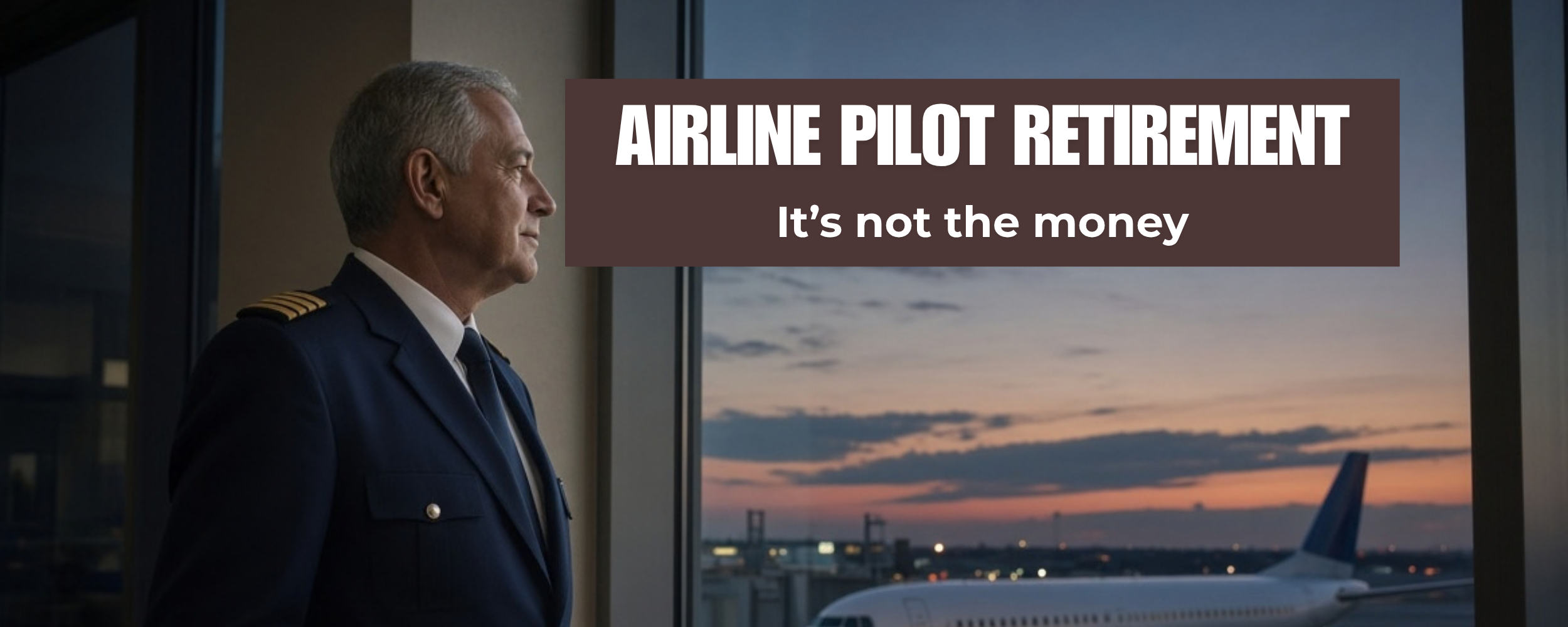
Airline Pilots: How to Enjoy a Healthy, Happy, and Fun Retirement at 65

Commercial airline pilots, let me be frank. Age 65 comes at you fast. If you’re not already thinking about your retirement health and lifestyle, now is the time. This article isn’t about money, pensions, or a 401(k). Today, we look at the non-financial aspects of retirement planning, like health and happiness.
I’m a physician, not a pilot. I specialize in helping pilots, dentists, and other busy professionals enjoy the best retirement. I call it retirement medicine. What’s that, you say? We cover what your financial planner doesn't: sleep, strength, who you come home to, and what you do on a Thursday afternoon when nobody is waiting for you at the gate.
As you well know, under 14 CFR Part 121, U.S. airlines cannot use you as a pilot once you turn 65. Congress looked at raising the age in 2024 and left it alone. Your airline planned the flying. You (presumably) planned the finances. Sadly, many pilots don’t plan the next chapter of life that begins the week after the last landing.
Here are four issues that are worth thinking through before you turn in the badge. Health. Your marriage. What you will actually do. And who you’ve got to do it with.
Let’s talk about health and longevity.
Flying takes a toll on your body. Lives are in your hands every day. Talk about stress and responsibility! You spend much of the day sitting. Sedentary lifestyles are no bueno. Early shows, red-eyes, and time-zone changes screw up your sleep. Meal timing (and quality!) depends on the trip, not your chef’s advice.
Circadian rhythm disruption in airline crews is well known. Sleep problems and fatigue are common on the line, and irregular hours, cabin time, and missed meals show up later as weight changes, high blood pressure, and greater risk for cancer and heart disease. The good news is you can now right the ship by identifying your risks and improving your health.
No more overnight work! As a result, some pilots sleep better within a month. Others keep waking at 4:10 because that is what your body learned. One of our first goals is to get your sleep schedule back on track.
A routine physical will tell you if something is already wrong, but that isn’t enough for a pilot. We want to know your 10-year risk for heart disease, muscle loss, and Alzheimer’s. The good news is that improved predictive technology can now give us a glimpse into your health future. For example, simple tests like grip strength, walking speed, and some specialized blood tests give us a solid window into your health future and expected lifespan.
Once we know where you stand, we act. Rebuilding sleep, strength, and diet can take months. Waiting until the badge is in the drawer just shortens our runway.
Let’s be candid. You have specialized health needs, and your risks aren’t the same as an accountant or plumber. You’ll want a doctor on your side who understands your health portfolio.
Get ready to see your spouse more. A lot more.
You may have been married a long time, but you probably still aren’t prepared for the change heading your way.
In your flying years, absence is expected. Four days gone, three days home, or whatever your category and base actually produced. You got good at coming back. Your spouse ran the house without you. That arrangement can be stable (and, maybe even ideal), but it is a poor rehearsal for retirement.
Retirement changes everything. Suddenly you are both in the same kitchen on a Wednesday morning, and neither of you has a script for it. Some couples love it immediately. Some discover that “we get along great” was partly true because you were not around enough to get on each other’s nerves. Both can be fixed. Neither fixes itself.
You probably know the old joke: I married you for life, not for lunch.
What does a good Tuesday look like for each of you? Who leaves the house, who wants to blast Ozzy, who wants friends over, and who's been waiting 20 years to have you around for the boring errands and now isn't sure they want a co-manager.
I know you’ve thought about this. Every pilot does. But are you ready? A little planning here saves a bad first year. I’ve seen couples do well when they treat the first six months like a new bid: a known schedule, known time apart, known time together, and a deliberate renegotiation.
Will you be bored?
Most new retirees I meet, other than pilots, want to travel. Dentists and surgeons may have spent 30 years working in one city, in one office. Now their calendar is wide open, and they see it as their big chance to finally go somewhere exotic.
You already went somewhere. Repeatedly. The novelty of an airport is gone. What you have not practiced is staying put at the casa.
This is a major issue that distinguishes airline pilot retirees from most others. Your identity was the uniform, the schedule, the mission, the crew. Take those away, and the calendar looks wrong. Some pilots want a clean break. Some want to instruct, fly corporate or charter, mentor, consult, or volunteer. Part 121 ends at 65. Other flying does not.
Wanting to keep flying is reasonable, and so is wanting to call it a day. The mistake is assuming the answer will show up after three months at home watching TV (or YouTube).
“What will you do?” is a real question, and it deserves a better answer than golf. Golf is fine. Golf four days a week, with no one expecting you, gets old for many people who spent a career being useful on a deadline.
Let’s think about how you’ll enjoy your days at home. It’s a great time to hit the gym, start a business, write a blog, launch a charity, or speak at conferences. Maybe you’ll even pick up pickleball. (It’s fun, by the way).
Be prepared to see your work friends less. Plan accordingly.
Crews feel like friends because, for a few days per week, they are. You eat together, handle the same problems, and share the same jokes about that nasty hotel in Memphis. Then the trip ends, and your “work friends” aren’t around so much.
When you stop flying, your bond of convenience and shared experience with your colleagues ends. A few people will text, but you’ll rarely see them in person. Candidly, they may not even call that much. You are no longer in the system that put you in the same room. They have their lives, and you have yours.
Pilots are often surprised by how fast their social lives change. You were not short on friends before. But now, who’s near you and wants to hit the wine bar Thursday evening?
Replacing your work friends takes longer than people expect. A monthly lunch with one retired captain is not a social life. The sooner you start developing non-work relationships with folks who live near you, the better. Whether you like it or not, now is the time to meet local friends. Nearby religious institutions, clubs, and charity organizations are great places to start. Even your HOA. The point is, you need repeated contact with people who share your interests and hobbies.
If your spouse has been your main non-work relationship for 30 years, retirement asks that one person to cover a gap your crew used to fill. That is a lot to put on a marriage. New friends are not a luxury item here.
Your lifestyle design starts now.
Retirement (or your next chapter) will be awesome. You need a plan for predictable problems that show up regardless of your bank account size.
Get a clear look at your health risks, sleep, and strength ASAP. Talk with your spouse about random Tuesdays, not just anniversaries. Decide whether you'll keep flying, and what non-flying work or project will replace the mission if you don’t. Start one local, repeating social thing before your work friends become Christmas-card lists.
I help commercial pilots navigate these challenges with our Buckhead Longevity Retirement Medicine program. It is the non-financial side of your next chapter: health, relationships, what you do on the ground, and fun. We offer virtual visits in Georgia, Texas, and California. I’m in Atlanta, which is convenient if you’re with Delta and based here. I am not affiliated with any airline.
Gregory Charlop, MD, DipABLM, is a concierge lifestyle and longevity physician, conference keynote speaker, and author in Atlanta. He founded Buckhead Longevity and helps pilots, dentists, and family offices with the health and life-design side of retirement.